
Go to the content
Federated websites: version 2.0 of the WordPress template released
Version 2.0 of the WordPress template for the Scuola’s federated websites has been released, introducing a new technical architecture, greater attention to accessibility and an AI-assisted development process.
5 October 2026
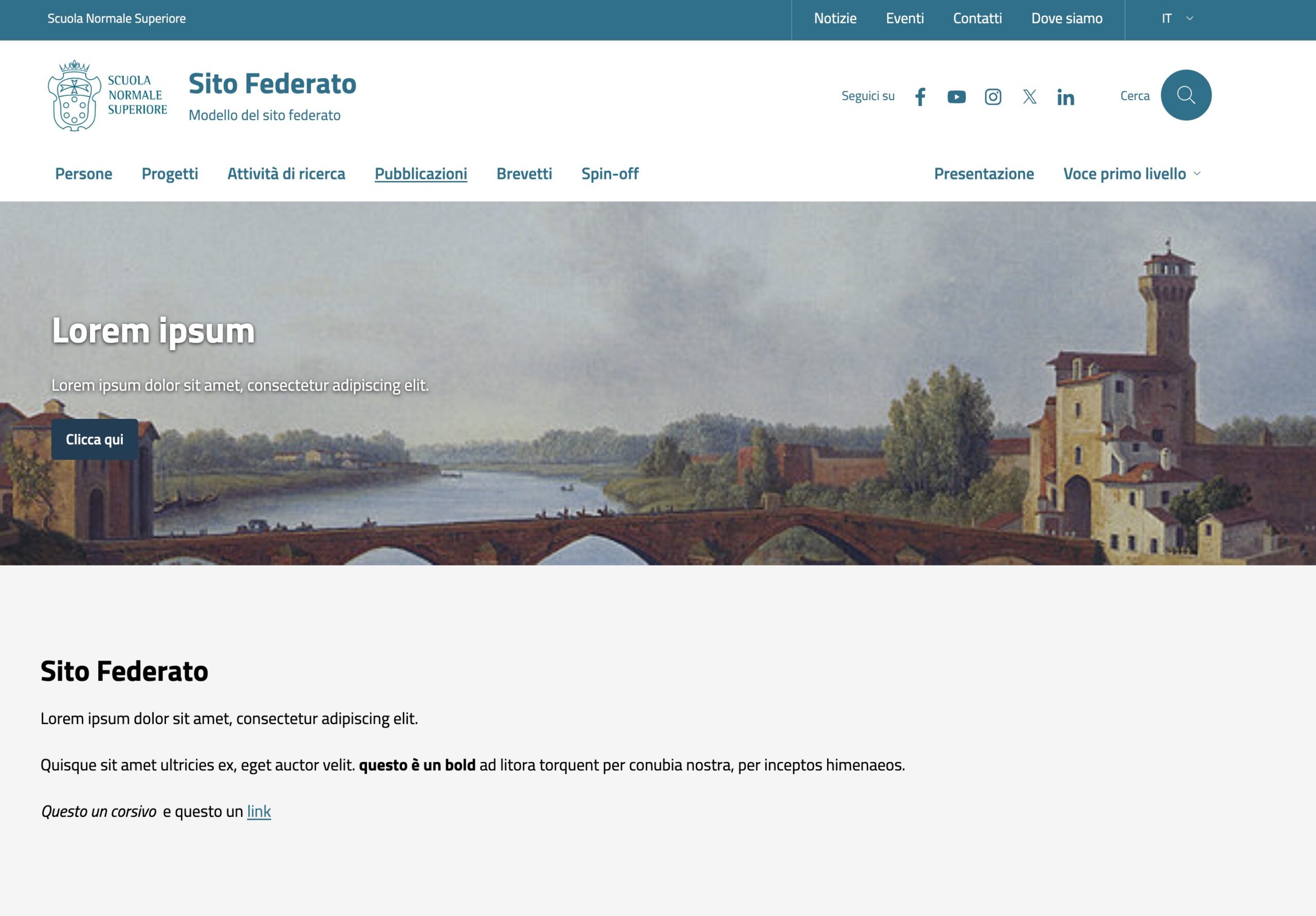
Version 2.0 of the WordPress template used to create the Scuola Normale Superiore’s federated websites is now available. The template is primarily intended for laboratories, research centres and research projects.
The new release includes a significant update to the theme’s interface and technical architecture, making it more accessible, easier to maintain and simpler to adapt to the visual identity of different organisational units.
More than a visual update
The main change is the migration to the new generation of Bootstrap Italia, the component library developed as part of Italy’s national design system for public administration websites and digital services.
This was not simply a redesign. The migration involved reviewing the website’s main components—including headers, menus, cards, search pages, navigation systems and footers—and adopting a new approach to managing colours, fonts and other interface elements.
The use of design tokens and CSS custom properties now makes it possible to apply the Scuola’s visual identity by changing a limited set of shared settings, without having to modify each component separately. The same approach also makes the template easier to customise and reuse by other public administrations and institutions.
Accessibility built into the development process
Accessibility was assessed throughout the project, from the HTML prototype used to test the new structure to its final integration into the WordPress theme.
Automated checks performed with tools such as Axe and Pa11y helped identify and correct issues involving heading hierarchy, keyboard navigation, alternative text for images and colour contrast.
These checks do not replace manual testing or continuous monitoring, but they help detect many potential problems during development, ensuring that accessibility is not considered only at the end of the project.
An AI-assisted development process
The new release also provided an opportunity to explore the use of an artificial intelligence assistant in a real-world software project.
Claude Code was mainly used to support the more repetitive parts of the migration: analysing templates, updating component markup and classes, locating the relevant sections of code and carrying out an initial review of the changes.
To reduce the risk of generating code based on incomplete or outdated information, the assistant was supported by Filo, an experimental MCP server developed by Daniele Tabellini that provides access to information about Bootstrap Italia and the Italian national design system.
Artificial intelligence was therefore used as a supporting tool rather than as an automated development process. Changes were developed in a separate environment, checked progressively and reviewed by a developer before release.
An open project available for reuse
The template is an open-source project published in Italy’s national catalogue of reusable public-sector software. Its source code and documentation are publicly available, allowing other public administrations to examine, use and adapt the solution.
The release of version 2.0 therefore represents more than a technical evolution of the Scuola’s federated websites. It also strengthens an approach to development based on shared standards, accessibility, transparency and public-sector software reuse.